

-
Products

-
-
-
After-sale Service
Introduction to the principle of Roots blowers?
Release time:
2022-03-28
The three-lobe impeller performs three suction and exhaust cycles with each rotation, using two impellers. Compared to the two-lobe type, it has less gas pulsation, lower vibration, and reduced noise. Driven by the synchronous gear, air is transported from the fan inlet along the inner wall of the casing to the discharge side. The internal cavity of the fan does not require lubricating oil, has a simple structure, operates smoothly, maintains stable performance, and is suitable for various applications, having been widely used in many fields. The working principle of the Roots blower: when the motor drives the drive shaft to rotate through a coupling or pulley, the gear mounted on the driving wheel drives the gear on the driven wheel to rotate synchronously in opposite directions, causing the meshing rotors to rotate together, thereby forming a space between the casing and the rotor where gas enters through the inlet. The gas is compressed and expelled through the outlet by the rotor, while the other rotor rotates to a relative position with the first rotor where compression begins, forming a new space on the other side of the casing, allowing new gas to enter this space and be expelled, achieving continuous movement for the purpose of blowing.
Each rotation of the tri-leaf impeller is done byTwoImpellers.ThreeTimes of suction and exhaust.ItCompared to the bi-leaf type, the gas pulsation is small, the vibration is also small, and the noise is low. Driven by the synchronous gear, the air is transported from the fan inlet along the inner wall of the casing to the discharge side. The internal cavity of the fan does not require lubricating oil, has a simple structure, operates smoothly, has stable performance, adapts to various Applications, and has been widely used in many fields.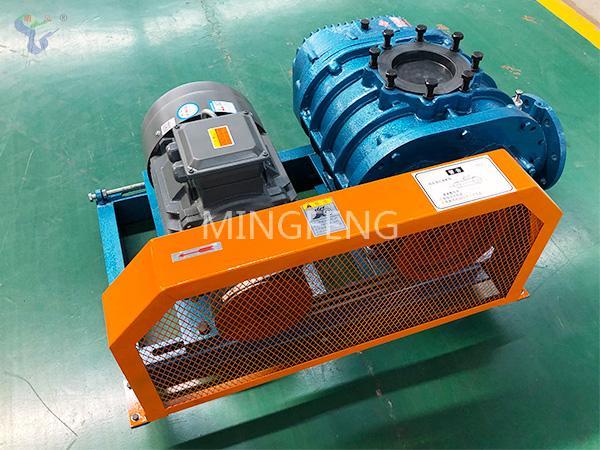 The working principle of the Roots blower: When the motor drives the active shaft to rotate through a coupling or pulley, the gear installed on the active wheel drives the gear on the driven wheel to rotate synchronously in opposite directions, causing the meshing rotors to rotate together, thus forming a space between the casing and the rotor, where gas enters the space from the intake. The gas is compressed and expelled from the outlet by the rotor, while the other rotor rotates to a relative position with the first rotor where compression begins, forming a new space on the other side of the casing, allowing new gas to Enter this space, which is then expelled, achieving continuous movement and thus the purpose of blowing.
Key words:

Submit information now to obtain the total solution of wind turbine
To provide users with high-quality products and convenient pre-sale, sale and after-sales service, reflecting the "Ming Feng" to make users satisfied with the whole process of service.
No. 1-3, West First Road North, Fenghuangshan Industrial Park, Puji Street, Zhangqiu District, Jinan City, Shandong Province
Free service hotline