

-
Products

-
-
-
After-sale Service
What is a Roots blower?
Release time:
2021-06-23

1. Working principle of Roots blower and Roots blower.
The Roots blower is a positive displacement blower, and the air volume delivered is proportional to the speed. The three-lobe impeller performs three suction and discharge actions for each rotation, which reduces gas pulsation compared to the two-lobe type, resulting in smaller load variations, high mechanical strength, low noise, and minimal vibration. Two three-lobe impellers are mounted on two parallel shafts, maintaining a small gap between the impellers, the elliptical casing inner surface, and each impeller. Due to the impellers rotating in opposite directions at a constant speed, a certain amount of gas surrounded by the casing and impellers is transported from the suction side to the discharge side. The impellers are always kept in the correct phase by synchronous gears, preventing any contact between them, allowing for high-speed operation without the need for internal lubrication. The structure is simple, operates smoothly, has stable performance, and is suitable for various applications, having been widely used in many fields.
2. Working principle of centrifugal blower (same as centrifugal pump).
When the motor rotates and drives the blower impeller, the gas between the blades in the impeller also rotates and is thrown out by centrifugal force, increasing the gas flow rate. This converts kinetic energy into static pressure energy during the flow, and as the fluid is pressurized, the static pressure energy is converted back into velocity energy, discharging the gas through the exhaust port, while a certain negative pressure is formed in the center of the impeller. Due to the negative pressure at the inlet, external gas is immediately drawn in under atmospheric pressure. With the continuous rotation of the impeller, gas is continuously discharged and replenished, achieving the purpose of continuous blowing. Under the same power, wind pressure and air volume are generally inversely proportional. With the same power, high wind pressure results in relatively low air volume, while large air volume leads to lower wind pressure, thus fully utilizing the motor's efficiency.
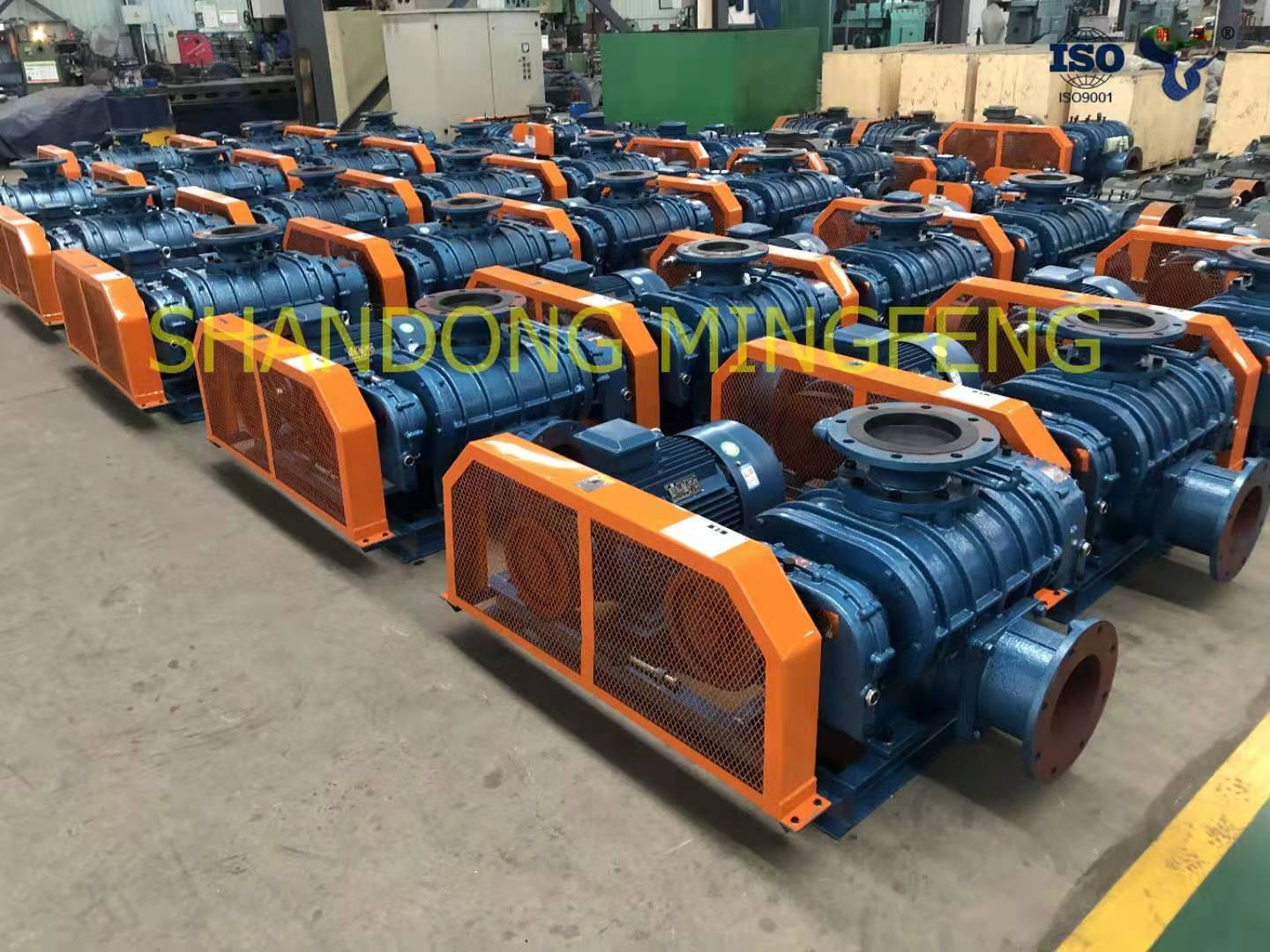
3. Structure and working principle of rotary blower.
Blower pressure range: 0.1-0.5 kgf/cm2. The structure of the rotary blower is compact, mainly consisting of the following six parts: motor, air transition device, blower body, air chamber, base (also oil tank), and oil drip nozzle. The blower operates with an eccentric rotor offset in the cylinder, causing the volume change between the four blades in the rotor slots to suck in, compress, and discharge air. During operation, the pressure difference of the blower automatically delivers lubrication to the oil drip nozzle, which drips into the cylinder to reduce friction and noise while preventing gas from flowing back into the cylinder.
4. Structure and working principle of centrifugal blower.
The thrust generated by the rotating blades compresses and propels the fluid, increasing its pressure energy and kinetic energy, as shown in the diagram. The impeller is installed inside a cylindrical (the blower is conical) pump casing. When the impeller rotates, the fluid flows axially in, gains energy in the blade passage, and then flows out axially.
Key words:

Submit information now to obtain the total solution of wind turbine
To provide users with high-quality products and convenient pre-sale, sale and after-sales service, reflecting the "Ming Feng" to make users satisfied with the whole process of service.
No. 1-3, West First Road North, Fenghuangshan Industrial Park, Puji Street, Zhangqiu District, Jinan City, Shandong Province
Free service hotline